You have an anniversary date, a frame on the shelf and a print deadline. Before ordering paper, check which moment the image will mark, download the full-size file and measure the frame's usable opening. Those three checks help you avoid a cropped caption or a print that does not fit.
Agree which moment the print marks
An anniversary might celebrate the ceremony, a first meeting or a date shared across two time zones. Choose the intended event and write its local date, clock time and zone down together. If the exact time is unknown, choose one and include it in the gift note.
On the dedicated Moon print maker page, the calculation inputs and the printed wording serve different purposes. Editing “Our anniversary” or a place name does not change the astronomical instant. Recheck the time-zone selection and the UTC status after choosing your date, then proofread every text line in the final saved PNG.
Use the exported pixels
The PNG export is 2400 × 3000 pixels. At 8 × 10 inches, each dimension gives 300 pixels per inch: 2400 divided by 8 and 3000 divided by 10. This is the tool's intended print size. Choose the “Dark midnight” or “Light ivory” paper swatch, then select “Download free print” to save the PNG. Use that file rather than a screenshot of the smaller preview.
The export includes nominal 300 dpi density metadata. That label helps software interpret physical size; the pixel dimensions determine how much detail is available at each size. At 12 × 15 inches the same file supplies 200 pixels per inch. Check with the printer before enlarging, particularly if the result will be viewed closely.
The image ratio is 4:5. Printing it edge-to-edge on a differently shaped sheet requires cropping or borders. Ask the print service to preserve the full composition, and examine its crop preview carefully around the caption and location line. When printing the saved file, an image application’s “fit to page” option can also alter size or introduce margins.
Measure the frame's opening
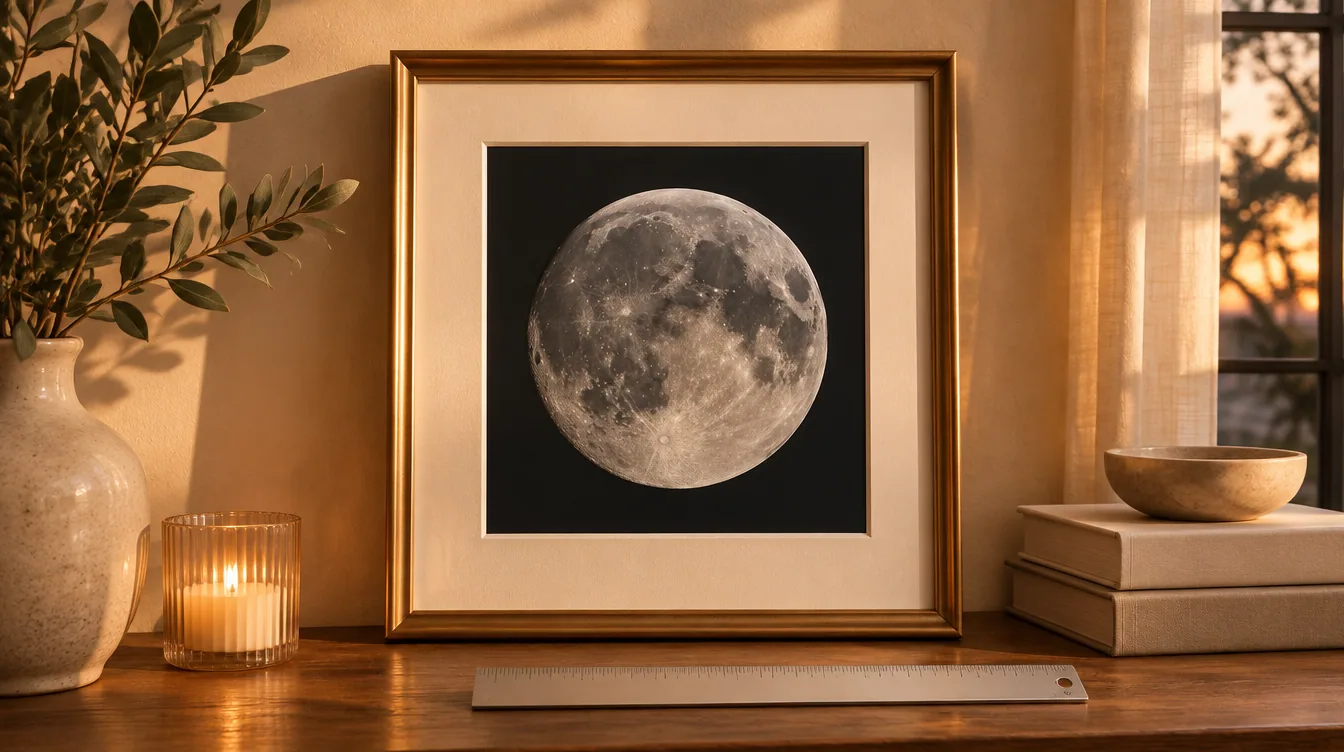
A frame's advertised outer dimensions do not necessarily describe the sheet it accepts or the visible mat opening. Confirm the supported print size, orientation and how much of the print the mat or frame lip covers. An 8 × 10 opening may hide a little at the edges; compare the actual overlap with your composition.
If you already own the frame, make a plain-paper size proof first. Measure the output, place it behind the mat and confirm that all four text lines remain readable. This checks fit cheaply before you pay for a finished print.
Compare paper using a small proof
The dark and ivory swatches change the print’s appearance on screen. Ask the printer about its available papers, ink coverage and handling guidance for your chosen style. A screen's luminous black and a paper print under room lighting can look different. Request a proof or paper sample to compare the finish under the room’s lighting.
The lunar illustration uses NASA surface data with calculated lighting. NASA's CGI Moon Kit explains the map resources; its photography guide provides useful context if you instead plan to print your own lunar photograph. Keep a photo's actual credit and permission with the file.
For a gift note, link to what a calculated Moon image represents. Pair the finished keepsake with a future outing chosen from the sky calendar or the next-event section. Choose an observing evening that fits your plans and check the local weather before going out.