
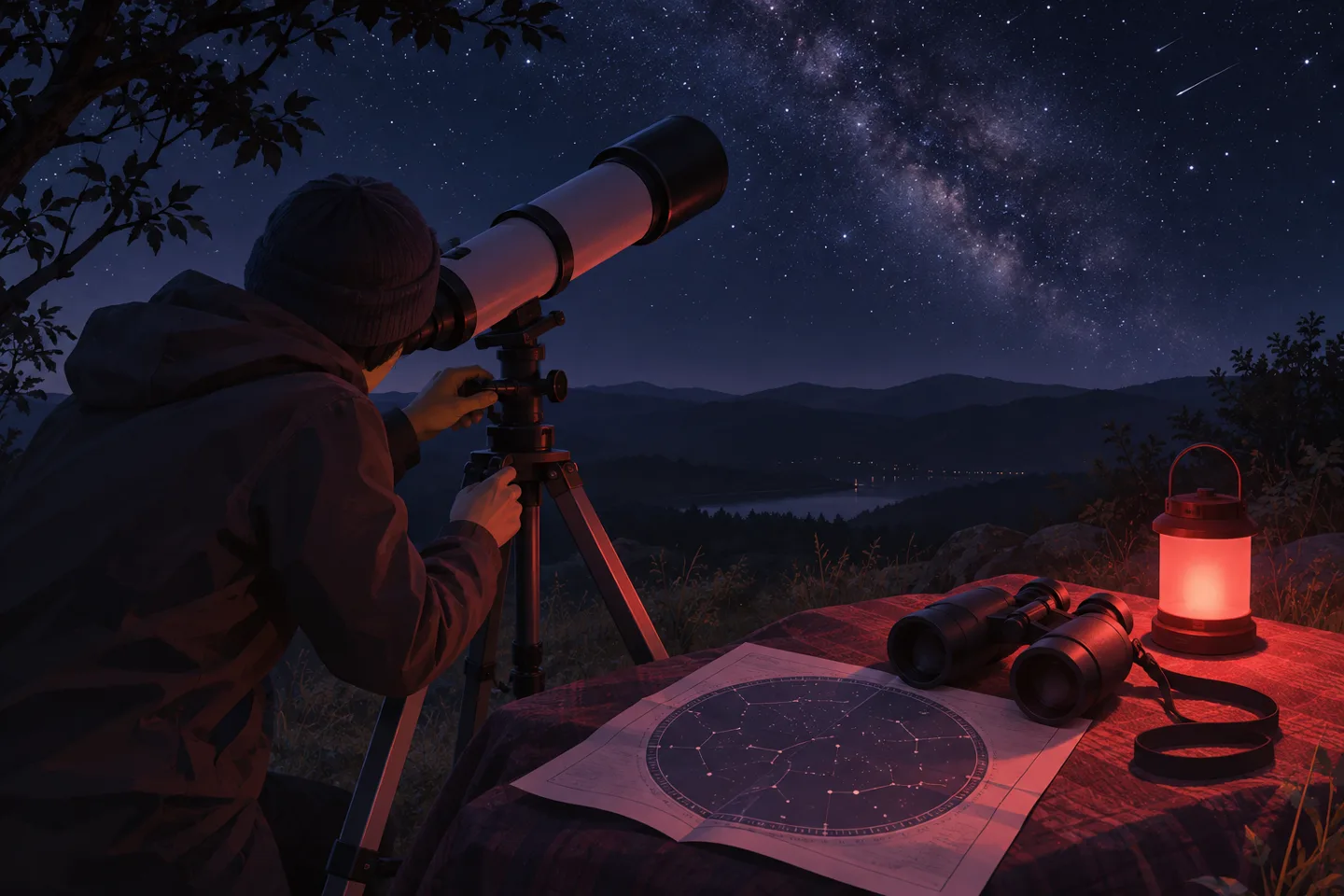
A telescope is an observing system: optical tube, stable mount, finder and eyepieces work together. More magnification on a box does not by itself tell you how easy the setup is to aim or carry.
Start with aperture and mount
As one concrete example, Celestron lists an 80 mm aperture and 900 mm focal length for its StarSense Explorer LT 80AZ. It uses a manual alt-azimuth mount and offers app-assisted finding with a compatible phone. Check the manufacturer’s current compatibility requirements and the actual configuration offered by the retailer.
Understand the eyepiece calculation
Divide telescope focal length by eyepiece focal length. A 900 mm telescope with a 25 mm eyepiece gives 36×; a 10 mm eyepiece gives 90×. Both eyepieces are listed in Celestron’s package description. A different telescope or eyepiece changes the result.
Compare carrying and setup
Celestron’s SkyMaster 15×70 binoculars are listed at 1,361 g with a tripod adapter. They are a different way to observe, not a substitute with the same field, tracking or magnification as a telescope. Consider where the equipment will be stored and whether you can carry the mount and tube safely.
Check compatibility before adding accessories
The Celestron Omni 32 mm uses a 1.25-inch barrel. Check the telescope’s focuser and diagonal rather than assuming every eyepiece will fit. These examples use manufacturer specifications; we have not performed hands-on comparative tests.
Compare the equipment examples · Try the binocular field tool